SLA clauses for healthcare vendors: a buyer's guide
SLA clauses for healthcare vendors: the metrics, remedies, BAA terms and exit rights US hospital and imaging center buyers should put in writing.

The SLA clauses healthcare vendors sign should do four things: define each service level in measurable terms, state how and when it is reported, attach a remedy that actually changes vendor behavior, and sit alongside a business associate agreement that covers security incidents. A service level agreement (SLA) is the part of a contract that turns a sales promise into an enforceable commitment. For a hospital, imaging center or radiology group, that means a contract you can hold a vendor to at 3 a.m., not a brochure.
- The U.S. Department of Health and Human Services (HHS) describes an SLA as a contractual agreement that specifies performance levels and the penalties that follow if the service is not delivered as contracted.
- ONC, the HHS Office of the National Coordinator for Health IT, warns that service credits are often drafted as the "sole and exclusive remedy," which can bar damages claims and termination.
- Under 45 CFR 164.314(a)(2)(i), a business associate contract must require the vendor to report security incidents, including breaches of unsecured PHI.
- An SLA clause is only as strong as its measurement rule: the start event, the stop event and the exclusions decide whether a number means anything.
- A teleradiology contract can commit to turnaround by priority tier, with the clock running from last-image arrival to radiologist signature.
TL;DR
- Write each service level as a committed number with a named start event, stop event and measurement window.
- Separate the SLA (how well and how fast) from the scope of work (what is delivered) and from the BAA (how protected health information is handled).
- Never accept service credits as the only remedy: add a cure period, a root-cause report and a termination right for repeated misses.
- Require regular performance reporting and a defined escalation path, and keep incident reporting duties in the BAA.
- Priority tiers matter: STAT, routine and stroke work should each carry their own clock.
Table of Contents
- Why does the publisher of this guide care about SLA clauses?
- What is an SLA in a healthcare vendor contract?
- Which SLA clauses should healthcare vendors agree to?
- How should an SLA define turnaround time and coverage hours?
- What reporting, monitoring and audit rights belong in an SLA?
- How do the SLA, the BAA and security incident duties fit together?
- What remedies should apply when a vendor misses an SLA?
- How do you check an SLA before you sign?
- How does AstraRad write its coverage plan?
- FAQ
- Sources
Why does the publisher of this guide care about SLA clauses?
We publish this guide because we sell what it describes: a contract with enforceable service levels. AstraRad is a US teleradiology service that delivers final signed reports read by board-certified subspecialists. Our revenue comes from per-report fees paid by hospitals, imaging centers and radiology groups, so we have a commercial interest in buyers who read contracts closely.
The clauses below apply to any healthcare vendor. We use teleradiology as the worked example because turnaround is the clearest case of a service level that affects patient care.
What is an SLA in a healthcare vendor contract?
An SLA is a section of a vendor contract that defines the performance the vendor commits to, how it is measured and what happens when it is missed. It differs from the scope of work, which lists what the vendor delivers. The SLA says how well, how fast and how reliably it is delivered.
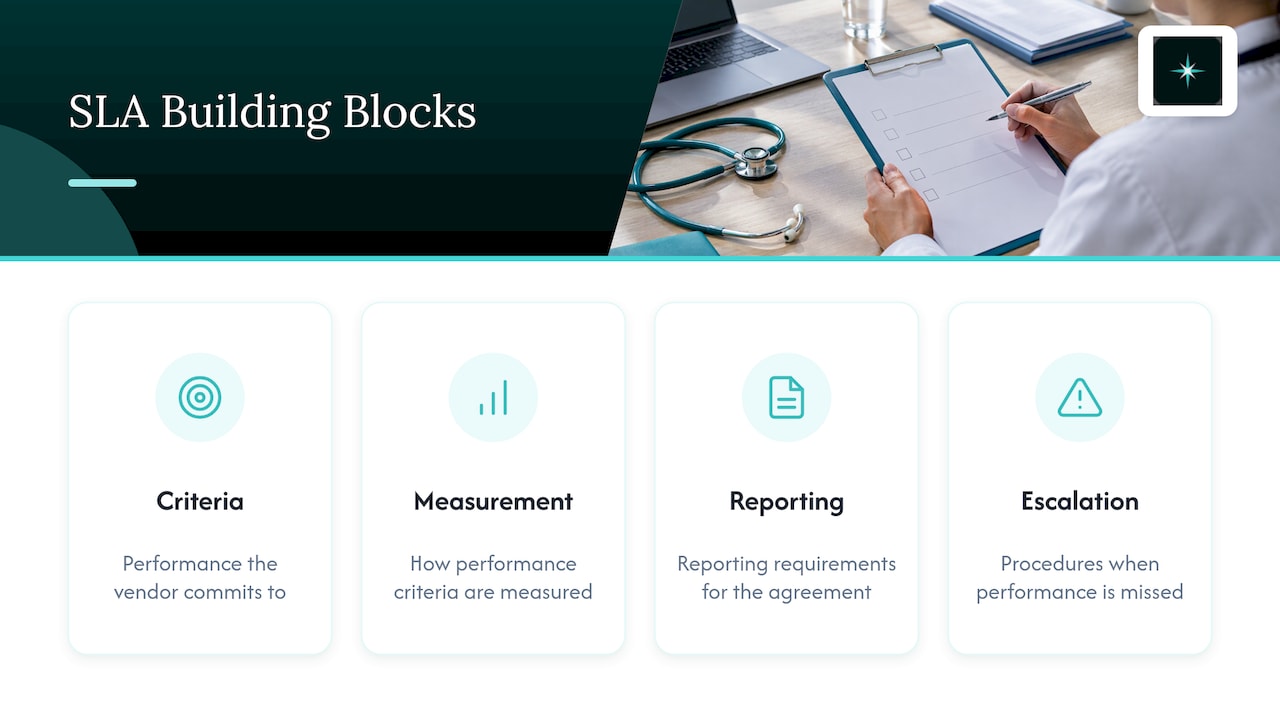
The HHS practices guide for service level agreements defines an SLA as a contractual agreement between a service provider and its customer that specifies performance levels and associated penalties. The same guide lists the building blocks buyers should look for: performance criteria, how those criteria are measured, reporting requirements and escalation procedures.
How does an SLA differ from a scope of work?
A scope of work is a description of services and deliverables. Take a vendor that reads imaging studies: the scope says which modalities and body parts are covered, which sites and PACS (the picture archiving and communication system where images are stored and viewed) it connects to, and that each study ends in a final signed report. The SLA says how many hours each priority level may take and how the vendor proves it.
Keeping the two apart matters in a dispute. A missed deadline is an SLA event with its own remedy. A study type the vendor never agreed to read is a scope question. Contracts that blend the two leave both sides arguing about which clause applies.
Why do SLAs need to be express warranties or commitments?
ONC's EHR Contracts Untangled guide explains that standard form contracts typically disclaim every warranty other than the express ones. Without an express commitment, the vendor may have no contractual duty to fix a problem. The practical risks ONC lists are systems unavailable at critical times, slow performance and unavailable reports. Your core performance requirements should therefore appear as written, enforceable commitments, not as marketing language in a proposal.
Which SLA clauses should healthcare vendors agree to?
A healthcare vendor should agree to seven core clauses: service levels with numbers, measurement rules, coverage hours, reporting, remedies, security incident duties and an exit path. The table shows what each should say and where drafts typically go wrong.
| Clause | What a strong version says | Where drafts go wrong |
|---|---|---|
| Service levels | A committed number for each priority tier or system function | A "target" or "best efforts" figure with no consequence |
| Measurement rules | A named start event, stop event and reporting period | The clock starts when the vendor chooses, or ends at a preliminary step |
| Coverage hours | Stated shifts, days and holidays, with overnight and weekend work included | Business-hours coverage described as "24/7" in marketing only |
| Reporting | A defined report, delivered on a schedule, with the raw data behind it | Reports available only on request |
| Remedies | Credits, a cure period, a root-cause report and termination rights | Credits as the sole and exclusive remedy |
| Incident duties | Security incident and breach reporting written into the BAA | Notice "as required by law" with no operational detail |
| Exit | Data return and transition help on termination | No transition obligation after notice |
Should every metric be the same for every service?
No. A peer-reviewed study of SLAs for healthcare systems, published in PMC in 2021, states that different clinical use cases need different performance indicators, such as latency for remote surgery and reliability for others. The lesson for a buyer: do not accept one generic metric set. A stroke study, a routine outpatient X-ray and a screening mammogram do not carry the same urgency, so they should not share a clock.
What should the availability clause cover?
For software and hosted systems, HHS says an SLA can address system availability and reliability, backup and data recovery, how data is returned after termination, and security responsibilities. HHS adds that SLA terms must not prevent the covered entity from accessing its electronic protected health information (ePHI) in a way that violates the HIPAA rules it cites. If a vendor's SLA lets it withhold your data during a billing dispute, that clause needs to change.
If you are comparing teleradiology metrics specifically, a guide to teleradiology SLA metrics for procurement walks through the measures buyers usually put in the schedule.
How should an SLA define turnaround time and coverage hours?
An SLA should define turnaround time as the elapsed time between a named start event and a named stop event, set separately for each priority tier. For a reading service, the cleanest version starts at last-image arrival and stops at radiologist signature of the final report. Anything looser lets the clock drift.
Turnaround time is the interval an SLA measures between receipt of the work and delivery of the finished product. Four drafting choices decide whether that interval means anything:
- Start event. "Order placed" and "last image received" can differ by many minutes on a large CT. Name the one you mean.
- Stop event. A preliminary read is not a final signed report. A final signed report is the radiologist-signed document that becomes part of the patient record, and the SLA should measure to that signature. A guide to turnaround time SLA language for teleradiology contracts shows how buyers phrase this.
- Priority tiers. STAT, routine and stroke protocol work should each have a separate clock. A STAT read is an interpretation requested on an emergency or time-critical basis, and it needs a much shorter commitment than a routine outpatient study.
- Coverage hours. State the days, the overnight shifts and the holidays. If overnight reads come back as preliminary only, the contract should say so, because the hospital still needs a final to close the loop.
How does AstraRad commit to turnaround?
AstraRad is a US teleradiology service that delivers final signed reports read by board-certified subspecialists. Our turnaround is committed by contract and measured from last-image arrival to radiologist signature. The commitments are:
| Tier | Committed turnaround |
|---|---|
| STAT | Under 4 hours (under 2 hours or under 1 hour on request) |
| Routine | 24 to 48 hours |
| Stroke protocol | Under 30 minutes |
Every tier ends in a final signed report, including overnight, on scheduled US shifts 24/7/365 with every read performed inside the United States. For benchmarks on how buyers set STAT expectations, see our page on STAT teleradiology turnaround and SLA terms.
Does the delivery method belong in the SLA?
Yes, because a signed report that never reaches the chart has not been delivered. State where the report lands: directly in your existing PACS or through an interface to the EHR. Our explainer on how signed reports reach your EHR over HL7 or FHIR covers the options. Our reports go straight into the client's existing PACS with no extra portal, DICOM conformant, and that is the kind of delivery term worth writing into a contract.
What reporting, monitoring and audit rights belong in an SLA?
An SLA should require scheduled performance reports, a defined escalation path and, where your risk analysis calls for it, documentation or audit rights over the vendor's safeguards. A commitment you cannot verify is a promise you cannot enforce, so reporting is part of the clause itself.
The HHS practices guide lists reporting requirements and escalation procedures among SLA best practices. In practice, buyers specify:
- Report content. Volume by priority tier, the percentage inside the committed time, the exceptions and the reason for each miss.
- Report frequency. Monthly is common, with immediate notice of a major miss.
- Escalation path. Named roles on each side, a response time for each level and a point at which executives get involved.
- Underlying data. The right to see the timestamps behind the summary figure.
HHS makes a point worth knowing for audit clauses. In its cloud guidance it says HIPAA does not expressly require cloud providers to provide security documentation or allow customer audits, but that a covered entity may require them based on its own risk analysis. That means audit and documentation rights come from your contract. Ask for them in the SLA or the BAA, and specify the detail, frequency and format of incident reports.
What quality reporting should a clinical service add?
For clinical services, performance means more than speed. A teleradiology contract can add peer review as a quality clause. Ours provides that 1 in 20 reports is independently double-read, blind, for peer review. You can ask any vendor to state its peer review rate, how discrepancies are classified and how often you receive that summary. Our page on what to expect from a teleradiology provider on SLAs, QA and reporting lists the questions in more detail.
How do the SLA, the BAA and security incident duties fit together?
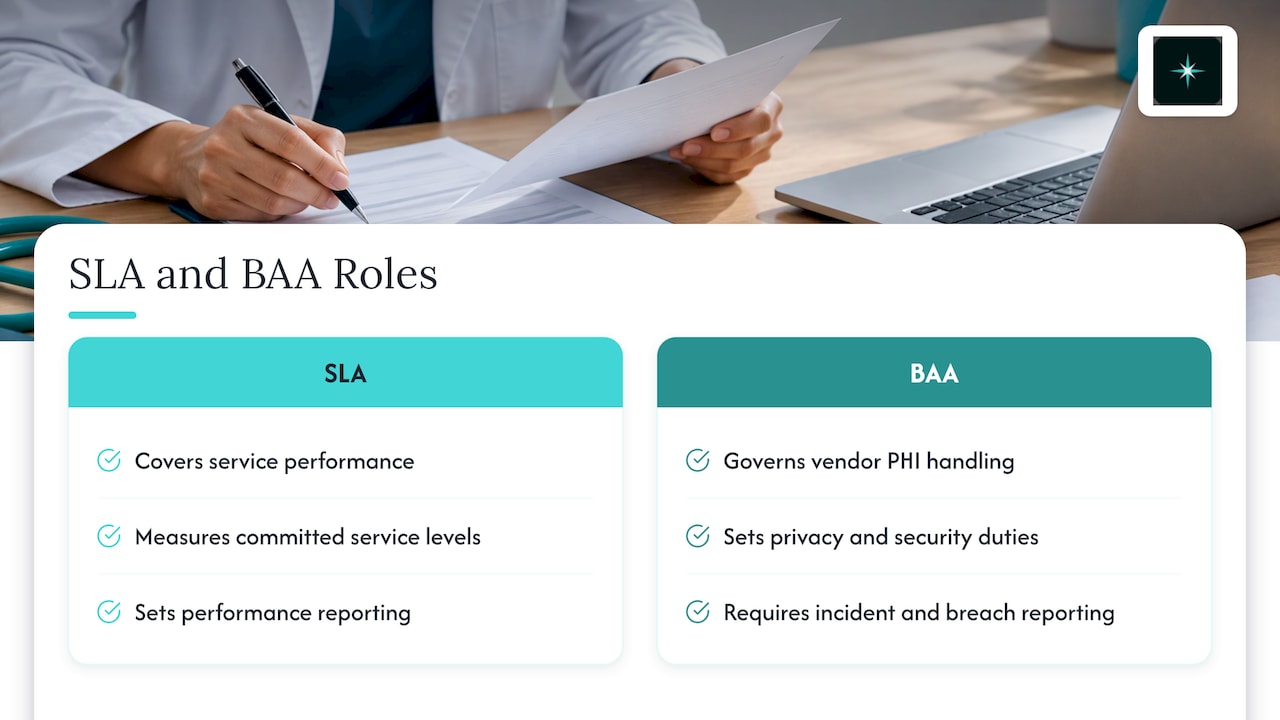
The business associate agreement (BAA) is the contract that governs how a vendor handles protected health information on your behalf, and it works alongside the SLA, not inside it. The SLA covers performance. The BAA covers privacy and security duties, including what the vendor must report and when.
Under 45 CFR 164.314(a)(2)(i), the business associate contract must require the vendor to comply with the applicable Security Rule requirements, make sure any subcontractors agree to the same requirements, and report security incidents to the covered entity, including breaches of unsecured PHI. HHS's business associate FAQs add that a BAA must bar uses and disclosures beyond what the agreement or the law permits.
Which BAA terms should you check against the SLA?
Check these points so the two documents never contradict each other:
- Incident definition. HHS defines a security incident as attempted or successful unauthorized access, use, disclosure, modification or destruction of information, or interference with system operations. Confirm the BAA uses that scope and states how fast the vendor must notify you.
- Subcontractors. If the vendor uses other parties, the BAA should flow the same obligations down to them.
- Data return. The SLA's exit clause and the BAA's end-of-contract terms should agree on how data is returned or destroyed.
- Credit carve-outs. An SLA that caps liability must not limit the vendor's BAA duties.
For a plain-language walk through vendor incident reporting duties and a covered entity's breach response, see these business associate agreement checks. To see how a radiology contract maps those duties, our guide to radiology BAA requirements for compliance officers is a practical reference.
What does AstraRad commit to on HIPAA?
AstraRad is a US teleradiology service that delivers final signed reports read by board-certified subspecialists. We are HIPAA aligned and work as a business associate under a signed BAA. Our radiologists are licensed in all 50 states, which matters for the credentialing and licensing questions that sit beside the SLA in a procurement file.
What remedies should apply when a vendor misses an SLA?
A good SLA remedy has four layers: a root-cause report, a cure period, service credits that scale with the miss, and a right to terminate after repeated failures. Credits alone rarely make a buyer whole, so the contract should not treat them as the end of the matter.
A service credit is a reduction in future fees that the vendor owes when it misses a service level. ONC's guide notes that SLAs can provide financial credits against future service fees, but are often drafted as the sole and exclusive remedy, which bars damages claims and termination. ONC advises negotiating an exception that allows termination for repeated failures, making sure the credits are sufficient and defining when a failure amounts to a breach of contract. It also says to get both legal and technical advice when evaluating SLAs, so your counsel should review the remedy language before you sign.
Health care counsel at Garfunkel Wild wrote in March 2026 that healthcare IT SLAs often define downtime so narrowly that maintenance and third-party failures are excluded. Read every exclusion in the definition before you compare vendors, because a high percentage with wide exclusions can be weaker than a lower one with none.
| Remedy layer | Purpose | What to write |
|---|---|---|
| Root-cause report | Explain the miss | A written analysis within a set number of days of each miss |
| Corrective action plan | Prevent a repeat | A dated plan with named owners |
| Service credits | Price the miss | A sliding scale tied to how far the vendor missed |
| Termination right | Exit a failing relationship | Triggered by repeated misses over consecutive periods |
| Transition help | Protect continuity of care | Obligation to keep serving while you move |
How do you keep credits from becoming the only remedy?
Add one sentence to the remedy clause stating that credits are not the exclusive remedy for chronic or material failure, and tie termination to a count of misses in a rolling period. Keep the trigger objective, such as a number of missed months out of a set period, so neither side has to argue about severity.
How do you check an SLA before you sign?
Check an SLA by reading it against five questions: is each number committed, is each clock defined, is each exclusion justified, is each report scheduled and is each remedy enforceable. Do this for every vendor on your shortlist in the same order.
- Committed or target? Look for the words "commits" or "shall," not "aims" or "targets." ONC specifically flags whether a percentage is a firm commitment or a target.
- Start and stop events. Write the two events on one line for each tier. If you cannot, the clause is incomplete.
- Exclusions. List what stops the clock. Each item should be outside the vendor's control and named.
- Reporting. Confirm the report, the frequency and who receives it.
- Remedy and exit. Confirm credits, cure, termination and transition help, plus data return.
A companion guide on teleradiology contract terms to negotiate puts these checks next to pricing, licensing and credentialing terms. For radiology buyers, add two clinical checks: whether every read is a final signed report, and whether the radiologist is matched to the modality and body part.
How does AstraRad write its coverage plan?
AstraRad is a US teleradiology service that delivers final signed reports read by board-certified subspecialists. After a discovery call, a coverage plan with SLA terms in writing follows, so you review the commitments before you sign. Pricing is per report with no minimums, and the first signed report arrives within 10 business days of countersignature.
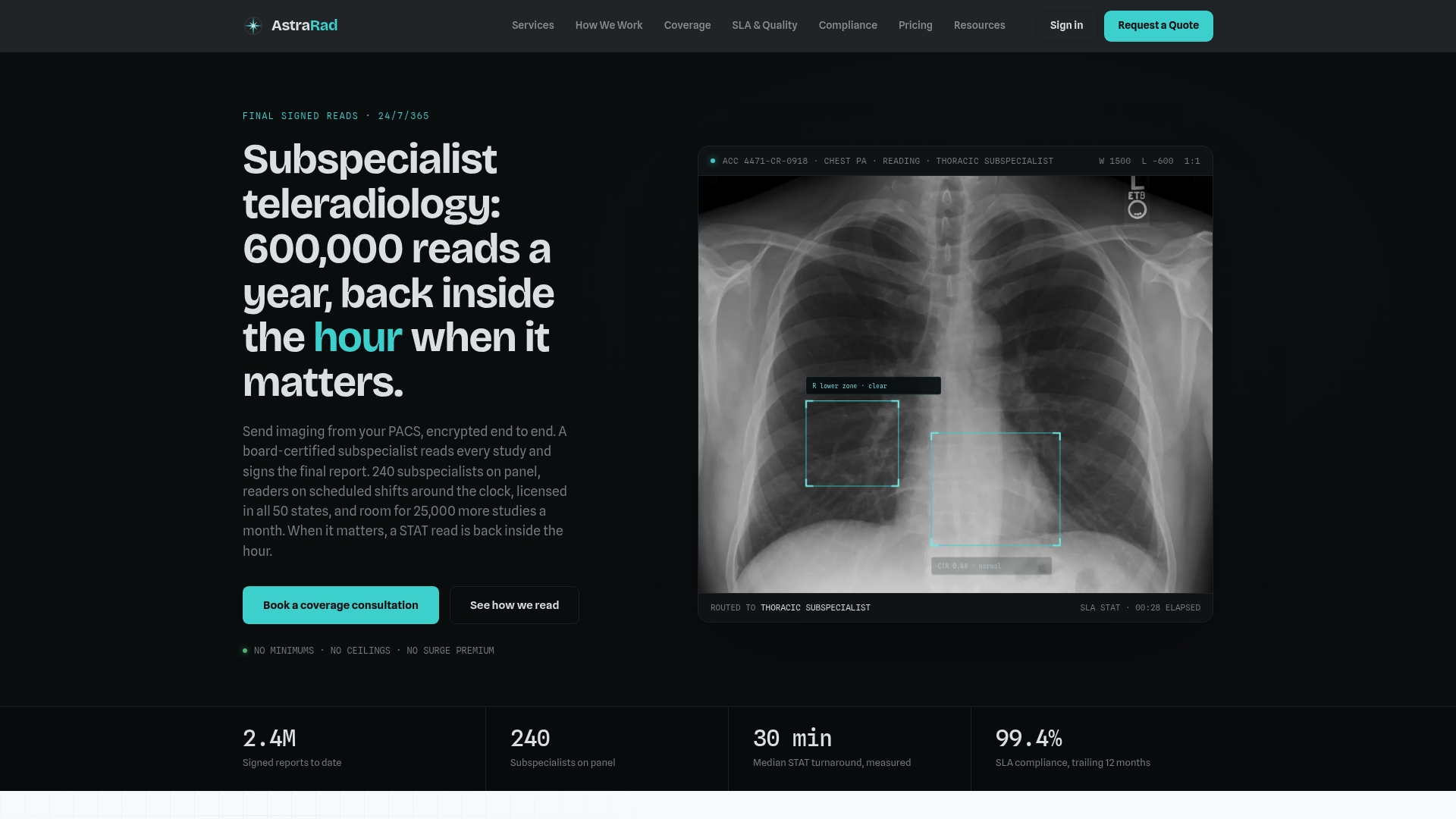
Every study is routed to a subspecialist matched to the modality and body part, across ten subspecialties and twelve study types. You can see the full range on our teleradiology services page, or request the per-report rate card, which is delivered within one business day.
Sources
- HHS, Service Level Agreement/Memorandum of Understanding Practices Guide
- ONC, EHR Contracts Untangled
- HHS, Guidance on HIPAA and Cloud Computing
- eCFR, 45 CFR 164.314 Organizational requirements
- HHS, Business Associates Frequently Asked Questions
- PMC, Service Level Agreements for 5G-Enabled Healthcare Systems (2021)
- Garfunkel Wild, Health Care IT Contracts: Eight Pitfalls to Avoid (March 2026)
- Business associate agreement checks
Ready to review SLA terms in writing? Book a discovery call or request the per-report rate card.
Frequently asked questions
What is an SLA clause in a healthcare vendor contract?
An SLA clause is a contract term that defines a measurable performance level, how it is measured and what happens if the vendor misses it. HHS describes an SLA as a contractual agreement that specifies performance levels and associated penalties. It sits next to the scope of work and, for vendors handling PHI, the business associate agreement.
What metrics should a healthcare vendor SLA include?
Include the metrics that match the service: availability and recovery for hosted systems, and turnaround by priority tier for clinical reading services. Each metric needs a start event, a stop event, a measurement period and a reporting schedule. Different clinical uses need different indicators, so avoid applying one generic set to every service.
Are service credits enough as a remedy?
Usually not. ONC notes that SLAs are often drafted so credits are the sole and exclusive remedy, which can bar damages claims and termination. Negotiate an exception that lets you terminate for repeated failures, make sure the credits are meaningful, and define when a miss becomes a breach of contract.
Does HIPAA require vendors to accept audits?
HHS says HIPAA does not expressly require cloud providers to supply security documentation or allow customer audits. A covered entity may still require them based on its risk analysis. Write the audit or documentation right into the SLA or BAA, including the format and frequency of incident reports.
How should an SLA treat STAT and routine work?
Give STAT and routine work separate clocks, each with a named start and stop event. For radiology, the stop event should be the signed final report, not a preliminary read. AstraRad commits to STAT under 4 hours, routine at 24 to 48 hours and stroke protocol under 30 minutes, measured from last-image arrival to signature.
Related on AstraRad
- Resources
Imaging center overflow reporting: how it works
Imaging center overflow reporting explained: when to use it, what to put in the contract, and how final signed radiology reports reach your PACS.
- Resources
What to ask a teleradiology vendor's references
Ask a teleradiology vendor's references for their worst month and what the vendor did. Includes a 12 question script and four deal stopping answers.
- Resources
Onboarding credentialing packet: what to include
An onboarding credentialing packet lists the documents, verifications and timelines hospitals and imaging centers need before a provider starts reading.
Put a radiologist's name on your next read.
Tell us your modalities and monthly volume. A complete per-report rate card, with turnaround tiers and SLA terms in writing, lands in your inbox within one business day.