Onboarding credentialing packet: what to include
An onboarding credentialing packet lists the documents, verifications and timelines hospitals and imaging centers need before a provider starts reading.

An onboarding credentialing packet is the set of forms, documents and releases a provider submits so your organization can verify qualifications, grant privileges and enroll the provider with payers before the first shift. Build it as one checklist that feeds credentialing, privileging and payer enrollment together, and start about 90 days before the start date. The same logic applies when the provider is a remote radiologist covering your studies under a teleradiology contract.
- NCQA's 2025 changes require files credentialed on or after July 1, 2025 to complete primary-source verification within 120 days before the decision, down from 180 days.
- Robert Wood Johnson Barnabas Health's credentialing FAQ sets 90 days before the start date as the benchmark for submitting an application.
- Ohio Revised Code Section 3963.06 requires a contracting entity to finish credentialing within 90 days, with a $500 per day civil penalty if it runs over.
- CenCal Health's April 2026 packet requires a 5-year work history with an explanation of any gap of 6 months or longer.
- AstraRad radiologists are licensed in all 50 states, and AstraRad works as a business associate under a signed BAA.
TL;DR
- A packet has three jobs: collect the application and documents, verify each credential at its primary source, and carry the file to privileges and payer enrollment.
- A file is incomplete until every item is verified, so missing documents and slow verification sources cause most delays.
- Start early, request the slowest verifications first, and track every open item in one place.
- For remote radiologists, license coverage in every state where your patients are located is the line item that most changes the workload.
Table of Contents
- What is an onboarding credentialing packet?
- Where does AstraRad fit in this process?
- What belongs in an onboarding credentialing packet?
- What are the steps to credential a provider?
- How long does credentialing take, and when should you start?
- What credentialing rules changed recently?
- How does a packet change for remote radiologists?
- How does AstraRad handle a new coverage contract?
- How do you keep a credentialing packet from stalling?
- FAQ
- Sources
What is an onboarding credentialing packet?
An onboarding credentialing packet is a standardized bundle of applications, supporting documents and signed releases that a new provider completes for a hospital, imaging center or radiology group. It gives the credentialing office everything it needs to verify the provider and move the file to committee review. The packet is the front end of a longer process.
Three terms keep the process clear.
Credentialing is the verification of a practitioner's education, training, work experience, license and other qualifications. The Indian Health Service describes it as obtaining evidence of qualifications to confirm the applicant has the experience, training and authority to practice within the privileges requested.
Primary-source verification is confirmation of a credential directly with the organization that issued it, such as a state medical board or a residency program, rather than from a copy the applicant supplies.
Privileging is the separate decision about which clinical services the provider may perform at your facility. Credentialing establishes who the provider is; privileging defines what the provider may do. Our guide on privileging versus credentialing covers the split in detail.
Onboarding is the wider employment or contracting workflow. Robert Wood Johnson Barnabas Health says its credentialing verification office works alongside human resources to align credentialing with employment onboarding, but the two remain separate processes. Treating the packet as its own workstream keeps a slow credentialing file from being mistaken for a slow hire.
Where does AstraRad fit in this process?
AstraRad is a US teleradiology service that delivers final signed reports read by board-certified subspecialists. We sell per-report teleradiology to hospitals, imaging centers and radiology groups, so we have a commercial interest in this topic, and we wrote this guide for buyers who must onboard and credential remote radiologists. Our radiologists are licensed in all 50 states, which shortens the licensure section of your checklist, and our teleradiology credentialing resource walks through the process from the buyer's side. Pricing is per report with no minimums.
What belongs in an onboarding credentialing packet?
A complete packet contains an application, proof of identity and education, licenses, board certification, DEA registration, liability insurance, work history, references and signed releases. Exact contents vary by specialty and by your medical staff bylaws. The table below combines items from published packets and national standards so you can build a master checklist.
| Packet item | What it proves | Where it is required |
|---|---|---|
| Application (state form or CAQH profile with ID) | Identity, history and attestations | CenCal Health, April 2026 |
| Diplomas or certificates | Education and training | Robert Wood Johnson Barnabas Health |
| Board certification and state license | Specialty standing and authority to practice | Robert Wood Johnson Barnabas Health |
| DEA registration, with an explanation of any missing schedules | Authority to prescribe controlled substances | CenCal Health, April 2026 |
| Professional liability coverage | Financial protection for claims | CenCal Health, April 2026 |
| Procedure logs for the prior 12 to 24 months | Current competence | Robert Wood Johnson Barnabas Health |
| Continuing-education documentation | Ongoing learning | Robert Wood Johnson Barnabas Health |
| Signed and dated release or acknowledgment | Permission to contact sources | CenCal Health, April 2026 |
What do national standards add to the checklist?
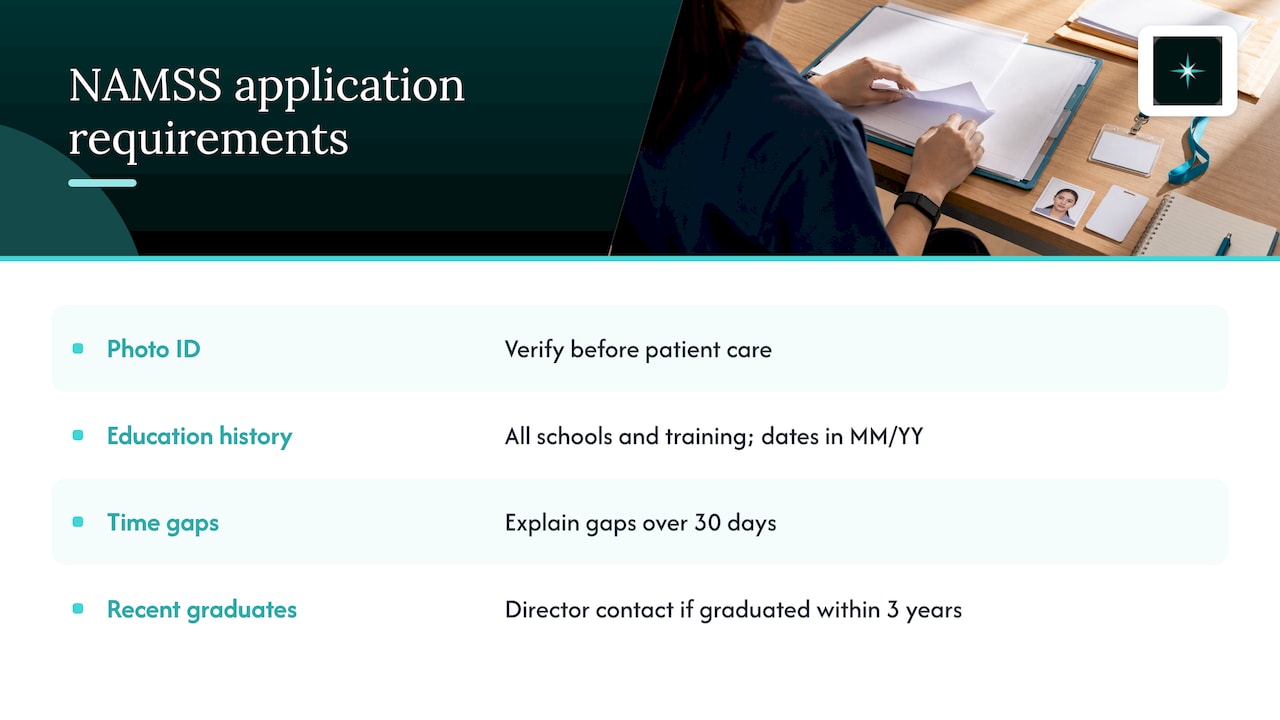
The Initial Credentialing Standards from NAMSS, the National Association Medical Staff Services, add specifics that prevent rework. NAMSS says government-issued photo identification must be verified before the practitioner provides patient care. Education history must list every school, internship, residency or fellowship with completion dates in MM/YY format, and explain any time gap greater than 30 days. Applicants who graduated within the past three years need the training program director's contact.
If you collect these fields on the first form, the credentialing office does not have to go back to the provider for them.
Which documents do advanced practice providers add?
Role-specific items belong in role-specific packets. The University of Texas Medical Branch lists, for nurse practitioners and physician assistants, a provider information form, a copy of the state license, a degree or transcript, certification and a supervising physician's information where applicable. Radiology groups that employ technologists or advanced practice staff alongside radiologists should keep a separate checklist for each role.
What are the steps to credential a provider?
Credentialing runs in a fixed order: collect the application, verify each credential at its primary source, review the file, then grant privileges. A file stays incomplete until verification finishes. The steps below show where each one usually goes wrong.
- Collect the application and documents. Send the full packet with a due date. The failure point is partial submission: the IHS manual says an application remains incomplete until verified by the primary source, so an unverified document does not count as received.
- Verify licenses in every relevant state. NAMSS requires a complete list of all independently held professional licenses with issuing state, type, number, status, and issue and expiration dates, and a current license in every state where the patient is located. It also directs medical staffs to query FSMB, the AMA Masterfile or the AOA Profile for unreported licenses. Our guide to verifying a radiologist's state medical license shows the check in practice.
- Verify education, training and work history. Gaps are the usual snag. Ridgeview Medical Center lists gaps in employment or education over 90 days among the items it must verify, and CenCal asks for an explanation of gaps of six months or longer. Set your own gap threshold in policy and put it on the form.
- Collect references. NAMSS requires references from a professional authority who worked directly with the applicant within the past two years, and the form must name the clinical privileges requested. References who never respond are a common cause of stalled files.
- Run sanction and exclusion checks. Ridgeview lists OIG, Medicare Opt Out and National Practitioner Data Bank checks among its required verifications. Under NCQA's 2025 standard, organizations must also determine whether practitioners are excluded from Medicare and Medicaid.
- Route the file for review. The file goes to a department chair and then to the credentials committee. CenCal, for example, has all applications reviewed by its Credentials and Peer Review Committee or a Medical Director.
- Grant privileges and enroll with payers. A single application can support medical staff membership, privileges and payer enrollment, according to Robert Wood Johnson Barnabas Health. Reusing it avoids asking the provider for the same data twice.
What if a primary source does not respond?
A primary source that does not respond leaves the file open. NAMSS guidance says the applicant is responsible for contacting the unresponsive source, and that secondary sources are appropriate only when the primary source no longer exists, subject to facility and accreditor rules. The IHS manual adds that when neither a primary nor a designated equivalent source can be obtained, you should contact the applicant's recent affiliations to learn how they obtained the verification, using the applicant's signed release.
How long does credentialing take, and when should you start?
Plan for about 90 days from complete application to decision, and begin before the provider's start date. Robert Wood Johnson Barnabas Health uses 90 days before the start date as its benchmark because slow verification sources and discrepancies need extra time. Published timelines vary by organization and by state law.
| Timing item | Figure | Source |
|---|---|---|
| Recommended application lead time | 90 days before start date | Robert Wood Johnson Barnabas Health |
| Verifications and missing-item requests | 90 to 120 days | Ridgeview Medical Center |
| Chair evaluation | 30 days | Ridgeview Medical Center |
| Committee and board review | 30 days | Ridgeview Medical Center |
| Applicant signature validity | 120 days | Ridgeview Medical Center |
| Ohio statutory completion limit | 90 days from the credentialing form | Ohio Revised Code 3963.06 |
Two details matter for scheduling. First, signatures on releases and attestations at Ridgeview are valid for only 120 days, after which second signatures are required if the file is not complete. A packet that sits unfinished can force the provider to sign again. Second, Ohio's statute allows the provider to submit the application before employment and imposes a civil penalty of $500 per day, including weekends, or retroactive reimbursement when the 90-day period is exceeded. That rule binds contracting entities in Ohio, so check your own state's law before you adopt it as a standard.
What credentialing rules changed recently?
The most relevant change for most buyers is NCQA's 2025 update. NAMSS Gateway reports that files credentialed or recredentialed on or after July 1, 2025 must complete primary-source verification within 120 days before the decision, replacing the former 180-day limit. Earlier files are evaluated against the historical requirements.
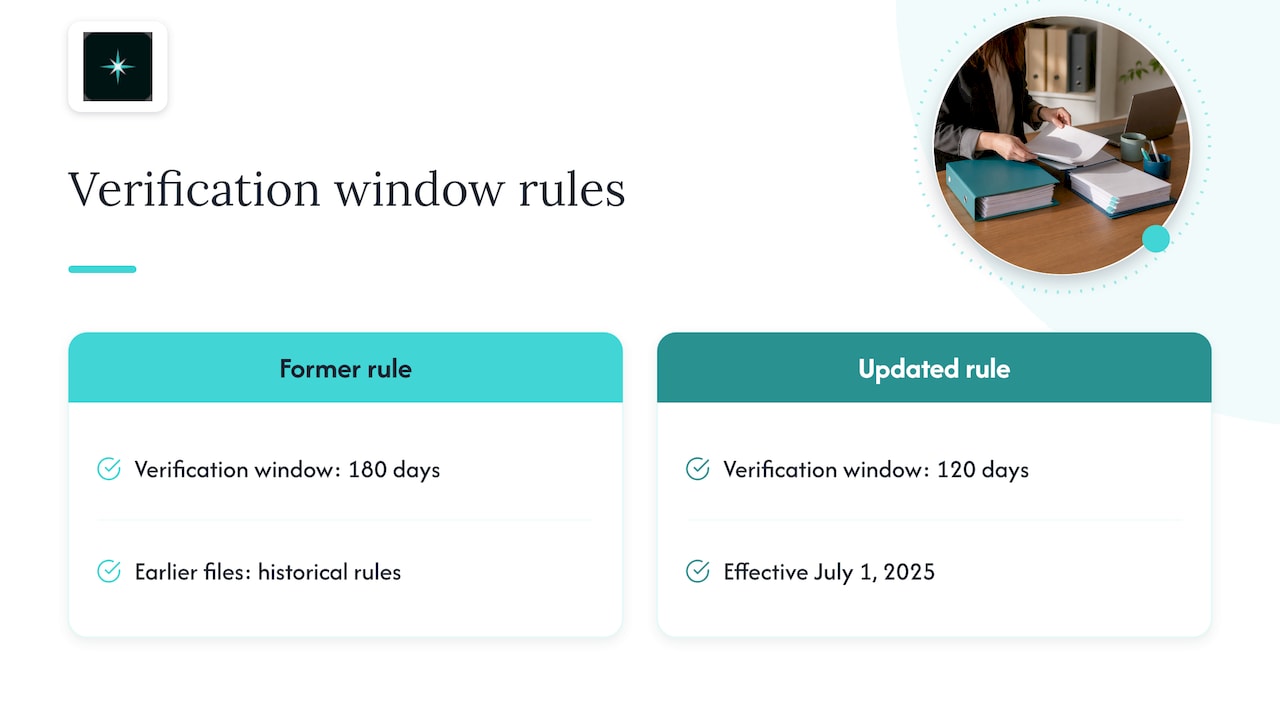
That shorter window changes how you sequence work. If a verification is completed early and the committee meets late, the verification can age out and need repeating. Match your verification requests to your committee calendar.
On the federal side, CMS publishes periodic updates to the Medicare provider enrollment instructions. Transmittal R13062PI, effective April 11, 2025, is the Sixteenth General Update to Chapter 10 of Publication 100-08. Transmittal R12796PI, effective September 16, 2024, is the Fourteenth General Update and clarifies enrollment policies for Form CMS-855 change transactions. Your enrollment staff should review the current instructions before filing, because the chapter is revised on a rolling basis.
How does a packet change for remote radiologists?
For a remote radiologist, the packet adds one dominant question: is the reader licensed where the patient is located? NAMSS requires a current license in every state where the patient is located, so a teleradiology contract multiplies licensure checks by the number of states your studies come from. Your packet needs the same core items as for an on-site physician, plus system access, data-protection terms and service levels.
A teleradiology contract also changes who does the work. With credentialing by proxy under CMS 482.22, a hospital can build its process around a defined arrangement rather than a separate full file for each remote radiologist, and our resource explains how that works for teleradiology buyers. Our state licensing overview shows how license coverage maps to the states you serve.
The table maps each packet item for a remote radiologist to what a buyer should confirm in the contract and what AstraRad commits to.
| Packet item | What the buyer confirms | AstraRad |
|---|---|---|
| State licensure | Current license in every state where the patient is located | Radiologists are licensed in all 50 states |
| Board certification and training | Subspecialty matched to the study | Every study is routed to a board-certified subspecialist matched to modality and body part |
| Where reads happen | Location of the reader | Every read is performed inside the United States |
| Service levels | Turnaround and escalation in writing | Turnaround is committed by contract, from last-image arrival to radiologist signature |
| Data protection | A signed agreement for protected health information | HIPAA aligned, business associate under a signed BAA |
| Systems access | Delivery into your workflow | Reports go straight into your existing PACS with no extra portal, DICOM conformant |
| Quality assurance | A peer review process | 1 in 20 reports is independently double-read, blind, for peer review |
| Commercial terms | Volume obligations | Per-report pricing with no minimums |
How does AstraRad handle a new coverage contract?
AstraRad is a US teleradiology service that delivers final signed reports read by board-certified subspecialists, for imaging centers, hospitals and radiology groups. Each study goes to a subspecialist matched to the modality and body part, across ten subspecialties and twelve study types, on scheduled US shifts 24/7/365. The first signed report arrives within 10 business days of countersignature.
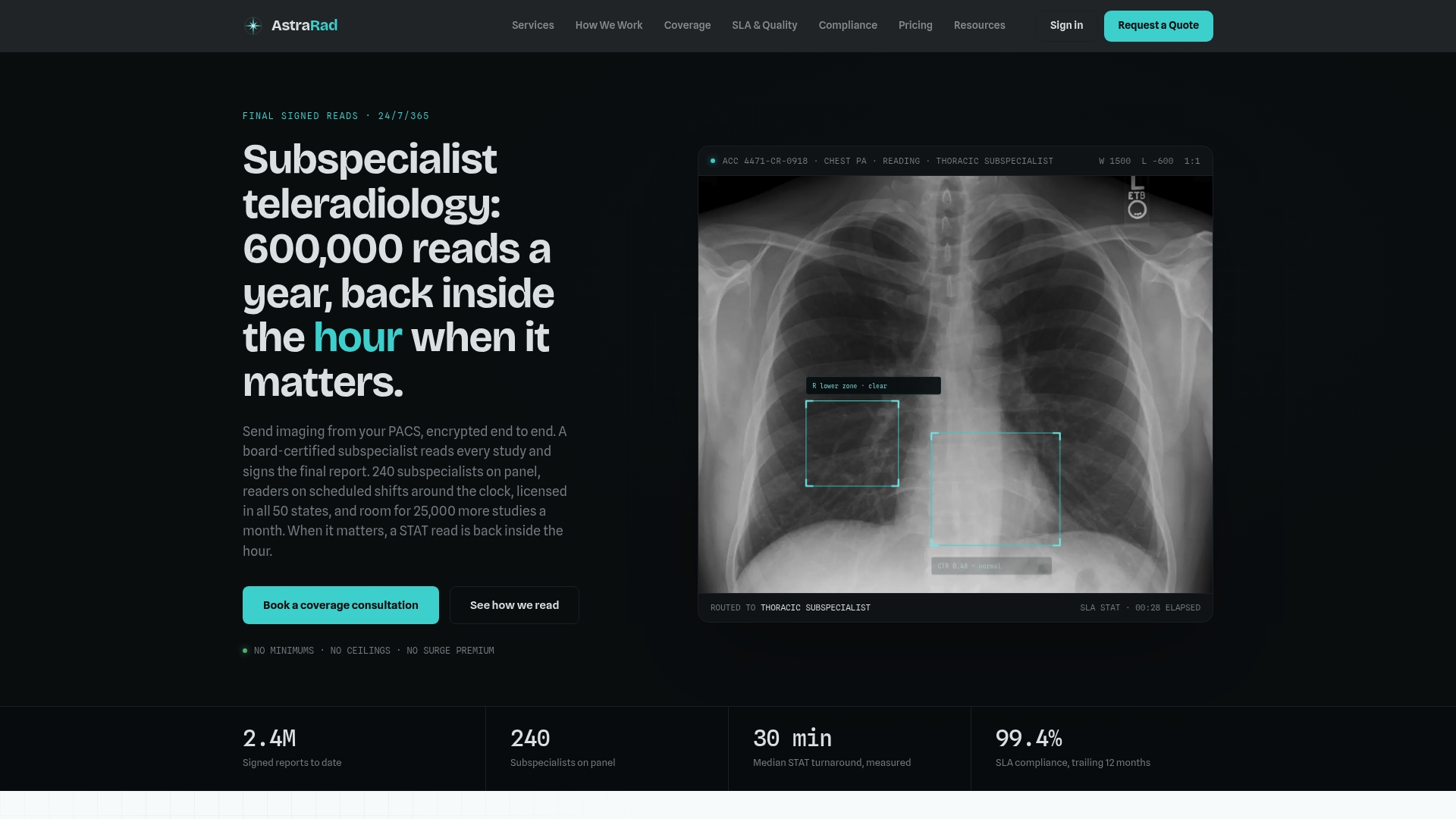
Turnaround is committed by contract. STAT is under 4 hours, with under 2 hours or under 1 hour on request, routine is 24 to 48 hours, and stroke protocol is under 30 minutes. A discovery call sets scope, and a coverage plan with SLA terms in writing follows. Browse the teleradiology services to match study types to your service lines.
How do you keep a credentialing packet from stalling?
You keep a packet moving by sending one complete set of forms, tracking every open item in one shared list, and requesting the slowest verifications first. Missing items are the main cause of delay, so the packet design matters more than reminders. These practices come from published credentialing procedures.
- Use a single packet. Ask for every document once, with a cover checklist. Duplicate requests invite inconsistent answers.
- Order requests by lead time. Ridgeview says it emails letters and requests the longest-running verifications first.
- Ask the provider to prompt sources. Robert Wood Johnson Barnabas Health notes that practitioners can greatly influence processing time by asking their verification sources to respond to the facility quickly.
- Name one point of contact. The same organization says a single verification-office contact speeds the gathering of information with minimal disruption to the provider's support staff.
- Use state board verification where the law allows. Ohio's statute lets a contracting entity accept the state medical board's primary-source verification of medical education, graduate medical education, examination history or ECFMG status instead of performing its own.
- Check what you may share. The IHS manual notes that paid verifications through AMA, AOA, NSC or ECFMG do not permit sharing results under their terms of use unless the area is set up as a formal centralized credentialing office. If several sites share a credentialing office, set that structure up first.
- Write the 13 criteria into policy. NAMSS recommends that each organization incorporate its 13 criteria into its rules and credentialing policies so the process is objective, systematic and free of bias.
An imaging center or radiology group that is replacing a reading partner should schedule packet work before the transition date. Our guide to switching teleradiology providers covers sequencing so coverage does not lapse.
Sources
- Robert Wood Johnson Barnabas Health: Centralized Credentialing FAQ for new providers
- Indian Health Service: Medical Staff Credentialing and Privileging SOP Manual
- Ohio Revised Code Section 3963.06
- CenCal Health: Physician Provider Onboarding Packet, April 2026
- UTMB Managed Care: Provider Enrollment
- NAMSS: Initial Credentialing Standards for initial practitioner applicants, February 2025
- NAMSS: Initial Credentialing Standards update, January 2024
- NAMSS Gateway: NCQA's 2025 credentialing standard changes
- Ridgeview Medical Center: Medical Staff Credentialing and Privileging
- CMS Transmittal R13062PI, effective April 11, 2025
- CMS Transmittal R12796PI, effective September 16, 2024
Ready to scope coverage? Book a discovery call or request the per-report rate card.
Frequently asked questions
What is the difference between credentialing and privileging?
Credentialing verifies a provider's qualifications, such as education, license, board certification and work history. Privileging is the separate decision about which services the provider may perform at your facility. Most organizations run both from one packet, but they are decided and recorded separately.
How early should we start an onboarding credentialing packet?
Start about 90 days before the provider's start date. Robert Wood Johnson Barnabas Health uses that benchmark because verification sources can be slow and discrepancies need time to resolve. Remote radiologists who read across several states may need more lead time, since licenses must be confirmed in each state.
Do work history gaps need an explanation?
Yes, and the threshold depends on the organization. CenCal Health asks for an explanation of any gap of six months or longer, NAMSS specifies explanations for education gaps over 30 days, and Ridgeview verifies gaps over 90 days. Put your threshold on the application form so providers answer it the first time.
Must a remote radiologist be licensed in the patient's state?
NAMSS's initial credentialing standards require a current license in every state where the patient is located. AstraRad radiologists are licensed in all 50 states, so license coverage follows your study mix rather than a fixed list of states. Confirm the state list in the written coverage plan.
What does a teleradiology contract add to the packet?
It adds a signed business associate agreement, written service levels, and a plan for delivering reports into your PACS. AstraRad works as a business associate under a signed BAA, and its turnaround commitments are set by contract and measured from last-image arrival to radiologist signature.
Related on AstraRad
- Resources
Imaging center overflow reporting: how it works
Imaging center overflow reporting explained: when to use it, what to put in the contract, and how final signed radiology reports reach your PACS.
- Resources
SLA clauses for healthcare vendors: a buyer's guide
SLA clauses for healthcare vendors: the metrics, remedies, BAA terms and exit rights US hospital and imaging center buyers should put in writing.
- Resources
What to ask a teleradiology vendor's references
Ask a teleradiology vendor's references for their worst month and what the vendor did. Includes a 12 question script and four deal stopping answers.
Put a radiologist's name on your next read.
Tell us your modalities and monthly volume. A complete per-report rate card, with turnaround tiers and SLA terms in writing, lands in your inbox within one business day.