Resident preliminary reads policy: what to define
A resident preliminary reads policy defines eligible studies, supervision, attending sign-off and discrepancy follow-up so your final reports stay timely.

A resident preliminary reads policy is the written rule set that says which studies residents may interpret on call, who supervises them, and how an attending radiologist reviews and signs the final report. A sound policy names the eligible studies, the supervision level by training year, the attending review window and the process for communicating discrepancies. Without those four pieces, preliminary reads can leave referring clinicians acting on reports that no attending has signed.
- Training threshold: the ACGME 2025 Diagnostic Radiology requirements bar residents from interpreting without direct supervision until they have completed at least 12 months of radiology rotations.
- Review window: the University of South Florida scope of practice requires an attending to review all on-call studies and issue the final report within 24 hours.
- Accuracy data: a 2025 meta-analysis of 616,918 preliminary reports across 20 studies found pooled major discrepancy rates of 1.35% for CT and 1.86% for MRI.
- Discrepancy handling: RSNA guidance tells each department to build its own process, list, documentation method and notification timetable.
- Outside coverage terms: AstraRad's contracts commit to STAT reads under 4 hours and stroke protocol reads under 30 minutes, measured from last-image arrival to radiologist signature.
TL;DR
- A preliminary read is a first interpretation by a resident. It is not the final signed report, and your policy should say so in plain words.
- Define eligible studies, supervision by training year, the attending review window, escalation steps and discrepancy communication in one document.
- Published data show major discrepancies are uncommon but rise with study complexity and fall as residents advance, so supervision should scale with both.
- Where the call schedule cannot guarantee attending review on time, a contracted final-read service can carry the overnight and overflow volume.
- Write each rule so it can be audited: who, what, by when, and where it is documented.
Table of Contents
- Where does AstraRad fit in a resident call model?
- What is a resident preliminary reads policy?
- What belongs in a resident preliminary reads policy?
- When can residents start issuing preliminary reads on call?
- How should attendings supervise, review and finalize preliminary reports?
- How accurate are resident preliminary reads?
- How should a policy handle discrepancies and critical findings?
- What escalation and coverage rules keep final reports on time?
- How should you write outside coverage into the policy?
- How do you roll out and audit the policy?
- FAQ
- Sources
Where does AstraRad fit in a resident call model?
AstraRad fits where a department wants every overnight or overflow study to reach a final signed report without waiting for the next attending shift. We publish this guide because we sell that coverage, and we want you to see how it relates to a resident policy.
AstraRad is a US teleradiology service that delivers final signed reports read by board-certified subspecialists. Every study is routed to a subspecialist matched to the modality and body part, on scheduled US shifts 24/7/365, with every read performed inside the United States.
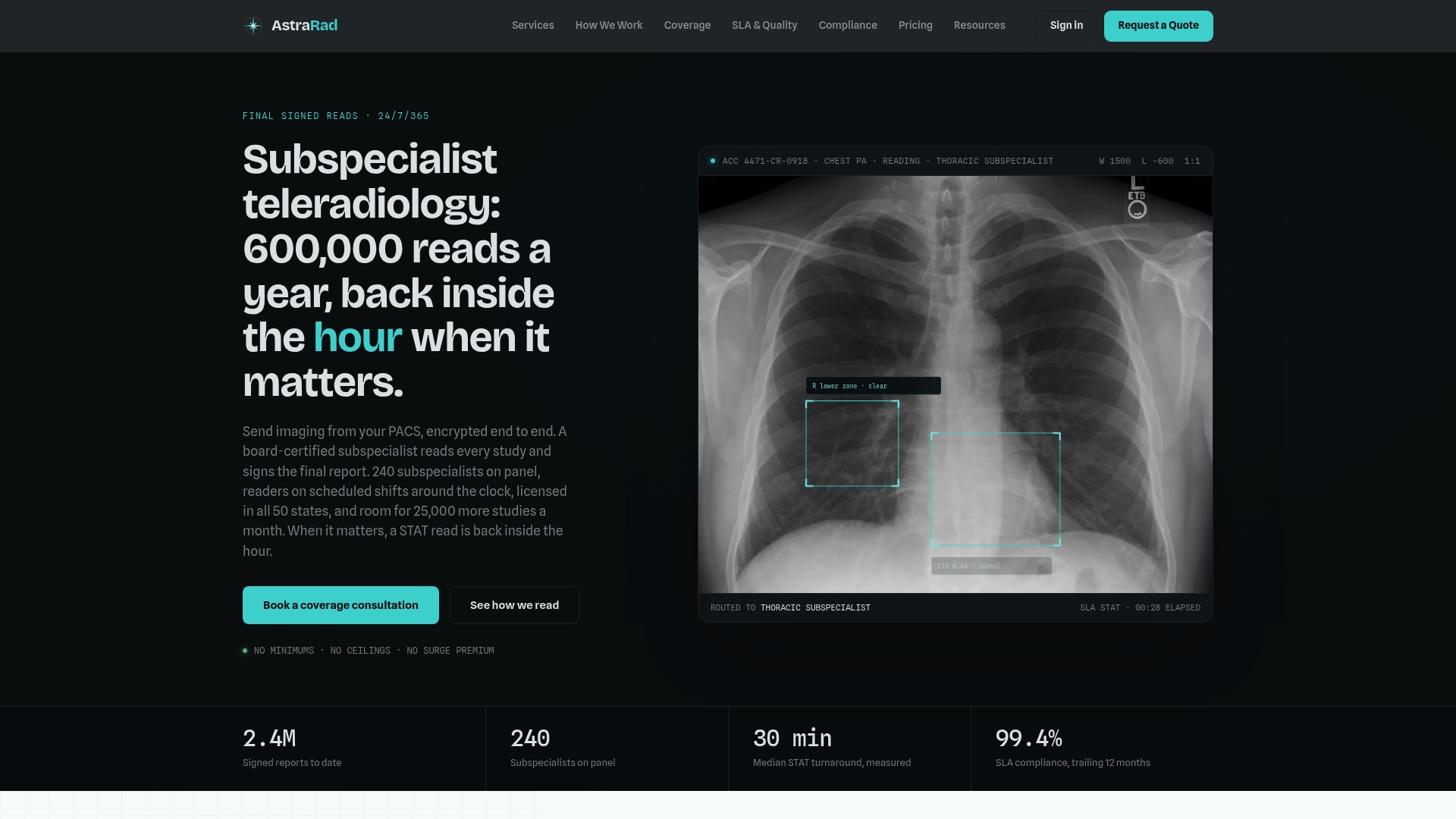
Turnaround is committed by contract: STAT under 4 hours, routine 24 to 48 hours, and stroke protocol under 30 minutes, measured from last-image arrival to radiologist signature. Reports go straight into your existing PACS, we work under a signed BAA, and pricing is per report with no minimums. You can review the full range of teleradiology services by study type before deciding whether a coverage layer belongs in your policy.
What is a resident preliminary reads policy?
A resident preliminary reads policy is a governing document that sets how trainees issue first-pass interpretations of imaging studies and how attendings convert them into final reports. It covers eligibility, supervision, documentation, review timing and communication of changes. It protects patients, the training program and the institution at once.
Two terms recur throughout the document, so define them early. A preliminary read is an interpretation issued by a resident before an attending has reviewed the images, often recorded in the EMR or reporting system so clinicians can act on it. A final signed report is the attending-authenticated interpretation that becomes the legal record of the study. Our explainer on STAT, preliminary and final reads separates these three report types for contract language.
The distinction matters commercially as well as clinically. When a referring service acts on a preliminary read, the hospital carries the exposure until the final report is signed. Policies that treat the preliminary as a clearly labeled interim step, with a defined path to a final signature, reduce that exposure.
What belongs in a resident preliminary reads policy?
A complete policy defines six elements: eligible studies, resident eligibility by training year, supervision level, the attending review window, discrepancy communication and escalation when review is delayed. Each element should state an owner and a documentation location so an auditor can verify it. The table below turns those elements into drafting prompts.
| Policy element | What to define | Example from published policies |
|---|---|---|
| Eligible studies | Which modalities and study types residents may preliminarily read; which are excluded | The USF scope of practice allows preliminary reports for non-interventional studies on call |
| Resident eligibility | Minimum training before independent call | 12 months of radiology training before call, per ACGME 2025 |
| Supervision | Direct, indirect with direct available, or indirect; who is the supervisor | Attending available on-site or by pager or telephone |
| Review window | When the attending reviews and signs | Within 24 hours of the on-call read at USF |
| Discrepancy handling | Definition, classification, who calls, how it is documented | RSNA: each department builds its own list and notification timetable |
| Escalation | What happens when a resident is uncertain or review is late | Named backup chain and outside coverage trigger |
The USF scope of practice is a useful drafting reference because it states that residents may issue preliminary reports for non-interventional imaging while on call, and that all on-call studies are subsequently reviewed with final reports issued by an attending within 24 hours. It also states that second-year residents may not take call without direct supervision until they complete twelve consecutive months of radiology training.
When can residents start issuing preliminary reads on call?
Residents may issue preliminary reads without direct supervision only after at least 12 months of radiology training under ACGME requirements. Programs then typically place resident call participation across PGY-3 through PGY-5. Your policy should restate this threshold, record who certifies readiness, and say what supervision applies before that point.
The ACGME Program Requirements for Diagnostic Radiology, effective September 3, 2025, add three details worth copying into policy language:
- Supervision during on-call activities comes from a senior resident, fellow or radiology faculty member, with a radiology faculty member available for direct or indirect supervision.
- On-call experiences must include interpretation, reporting and management of active cases.
- On-call experiences must not be administrative roles made up mainly of re-reviewing previously reported cases.
The third point shapes how you design the overnight schedule. A program that staffs residents only to re-check finished reports does not meet the requirement, so the policy should describe on-call as live interpretation with an attending backstop.
For a hospital buyer, this threshold also drives a staffing question: how many hours of the week fall in a period when only junior residents are on site? Those hours are where a policy depends most on attending availability, and where contracted coverage is most often evaluated.
How should attendings supervise, review and finalize preliminary reports?
Attendings supervise by being reachable, reviewing every preliminary read within a stated window and issuing the final signed report. A common standard is final sign-off within 24 hours, with the attending available on-site, by pager or by telephone. The policy should state the window, the channel and the record of review.
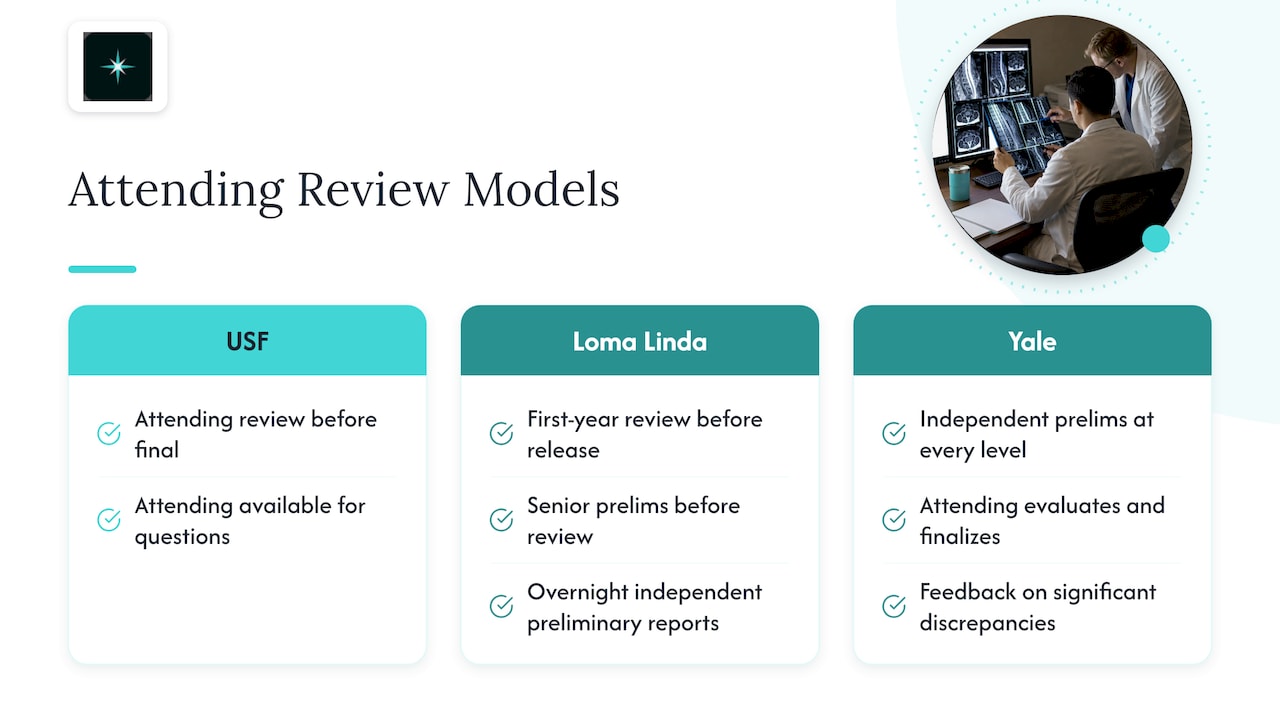
Published policies show variation worth deciding deliberately. The USF document says residents review all imaging examinations with an attending before a final report is submitted, and that an attending is available for questions. Loma Linda's resident FAQ describes a tiered approach in which first-year residents have all studies reviewed by an attending or senior resident before release, while more senior residents send preliminary reads to the EMR ahead of attending review, with studies done overnight receiving independent preliminary reports that an attending reviews afterward (Loma Linda Radiology).
A Yale study published in AJR in 2016 found that participating attendings let every resident, whatever their seniority, form an independent preliminary report that the attending then evaluated, modified and finalized before release, with feedback expected on significant discrepancies (AJR, 2016). That feedback loop is a policy element in its own right. Specify who gives feedback, in what system and how quickly.
The quality side of this is measurable. Our guide to RADPEER scoring lays out a six-step QA checklist that can be adapted to score the gap between resident preliminary and attending final reads.
How accurate are resident preliminary reads?
Resident preliminary reads are accurate in the large majority of cases. A 2025 meta-analysis of 616,918 reports found pooled major discrepancy rates between 0.38% and 1.86% depending on modality, with rates falling as residents advance. Your policy should use these figures to set supervision intensity by study type and training year.
The Academic Radiology meta-analysis pooled 20 studies and reported the following major discrepancy rates:
| Category | Pooled major discrepancy rate |
|---|---|
| Ultrasound | 0.38% |
| Radiographs | 0.64% |
| CT | 1.35% |
| MRI | 1.86% |
| First-year residents (R1), all modalities | 1.27% |
| Fourth-year residents (R4), all modalities | 0.67% |
| R1 residents reading MRI | 8.70% |
The last row is the figure a policy author should notice. Overall rates are low, yet early-year residents reading MRI showed the highest rate in the analysis. A policy can respond by requiring direct or same-session attending review for junior residents on cross-sectional studies, while allowing more independence on radiographs and ultrasound.
An older reference point comes from AHRQ PSNet, which reports minor discrepancies in resident readings in 3% to 7% of cases and major discrepancies that may alter patient care from under 1% to about 2.3%, and notes these rates resemble interobserver differences among attending radiologists. A major discrepancy is a difference between the preliminary and final interpretation that may change the patient's diagnostic workup or management.
How should a policy handle discrepancies and critical findings?
A policy should define a discrepancy, classify its significance, name who contacts the ordering service, set a notification timetable and require documentation in the final report. RSNA recommends each department develop its own process and list rather than adopt a generic one. The goal is that no clinician acts on an outdated preliminary read.
RSNA's guidance on communicating significant changes in interpretation, updated in 2014, defines a discrepant test result as an interpretation significantly different from a preliminary one that the patient care team could access, where the new interpretation may alter diagnostic workup or management. It recommends that each department develop a process, create its own list, choose documentation methods and set a timetable for notification.
Published institutional policy shows what that looks like in practice. The University of Toledo's radiology policy, approved in May 2026, has residents record on-call preliminary interpretations for attending review the next day. When the final report differs significantly, it documents that the discrepancy was noted and that the ordering service was reached by phone and told of the change (University of Toledo).
AHRQ PSNet stresses that timely next-day review of off-hours cases and immediate communication of discrepancies are critical, so referring physicians can base decisions such as surgery on the most current reading (AHRQ PSNet). Write that into the policy as a deadline, not a goal: name the hour by which overnight preliminaries must be reviewed.
A workable discrepancy section includes:
- A written definition of a significant discrepancy that matches your department's list.
- A named role responsible for calling the ordering clinician.
- A required statement in the final report that the change was communicated, to whom and when.
- A feedback record that returns the case to the resident for learning.
What escalation and coverage rules keep final reports on time?
Escalation rules name who a resident calls when uncertain, who steps in when attending review is late, and when outside coverage takes over. A policy that stops at "call the attending" fails the first time the attending is in a procedure. Define a backup chain with a time trigger at each step.
Three coverage models appear most often. The table compares them on the points a procurement team weighs.
| Coverage model | How the final report is produced | What the contract or policy must state |
|---|---|---|
| Contracted final-read service | A subspecialist signs the final report, including overnight | Turnaround commitments, credentialing and licensing, BAA, PACS delivery |
| Resident preliminary with overnight attending | Resident issues the prelim, in-house attending reviews and signs | Attending availability, review window, escalation chain |
| Resident preliminary with next-day attending review | Resident issues the prelim, attending signs the following day | Review deadline, discrepancy notification, labeled interim report |
Published call guides illustrate time triggers. Creighton University's supervision policy provides indirect supervision with direct supervision immediately available for PGY-2 to PGY-5 residents on call, with preliminary reports reviewed by on-call staff until 11 PM and studies read between 11 PM and 7 AM reviewed the following day (Creighton University). The next-day gap in that design is exactly what a labeled preliminary and a firm review deadline are meant to manage.
For overflow, a typical trigger is a queue time or a count of unread STAT studies. If a trigger fires, the study goes to a contracted reader whose report is final on arrival. AstraRad is built for that role: STAT CT reads and X-ray and ultrasound overflow reads each come as final signed reports into your PACS, so the escalation step ends with a signature rather than another preliminary.
How should you write outside coverage into the policy?
Write outside coverage as a named escalation step with a trigger, a turnaround commitment and a reporting standard. The contract should state turnaround as a committed term, define how it is measured and require final signed reports. Then the policy and the contract describe the same workflow.
Use this checklist when aligning the two documents:
- Measurement point. Define turnaround from last-image arrival to radiologist signature, so both sides count the same minutes.
- Tiers. Match your policy's categories to the contract's tiers. AstraRad's tiers are STAT, routine and stroke protocol, with committed times of under 4 hours, 24 to 48 hours and under 30 minutes. Shorter STAT windows of under 2 hours or under 1 hour are available on request.
- Credentialing and licensing. Require evidence that readers are board-certified and licensed in the state where the patient is imaged. AstraRad's radiologists are licensed in all 50 states.
- Report type. Require a final signed report at every tier, including overnight.
- Quality assurance. Ask for a stated peer-review rate. AstraRad independently double-reads 1 in 20 reports, blind, for peer review.
- PACS delivery. Require delivery into your existing PACS, DICOM conformant, with no extra portal for your clinicians.
- Privacy. Require a signed BAA. AstraRad is HIPAA aligned and works as a business associate under a signed BAA.
- Pricing structure. Compare per-report pricing and minimum-volume terms across proposals. AstraRad prices per report with no minimums.
Turnaround language needs particular care in the emergency department. Our guide to ED imaging turnaround contract terms covers what to specify, and the overview of teleradiology turnaround times for hospitals explains how tiers are usually defined. For a broader checklist, see what to require before signing a teleradiologist contract.
How do you roll out and audit the policy?
Roll out the policy with a written approval date, a named owner and a recurring audit of preliminary-to-final concordance. Departments should review the policy whenever accreditation rules change, and ACGME's 2025 requirements are the current baseline. Audit results should flow back to the residency program and to the department's quality committee.
A practical audit routine has four parts:
- Sample. Pull a defined set of preliminary-to-final pairs each quarter, weighted toward MRI and CT, where published discrepancy rates are highest.
- Score. Classify each difference using your department's significance list, and track the share that was communicated within the notification timetable.
- Time. Track how long overnight preliminaries wait for attending review against the window your policy sets.
- Act. Adjust supervision rules by study type and training year when the data warrant, and revisit your outside-coverage triggers if review delays recur.
The ACGME states that patient care in graduate medical education is delivered with faculty supervision and conditional independence, so residents can build the judgment needed for autonomous practice. A policy that is specific about who supervises what, and when, is how an institution shows that principle in daily operations.
Sources
- ACGME Program Requirements for Graduate Medical Education in Diagnostic Radiology, 2025
- University of South Florida, Diagnostic Radiology Scope of Practice, 2025
- Academic Radiology, On-Call Radiology Resident Preliminary Report Major Discrepancy Rates, 2025
- RSNA, Communication of Significant Change in Interpretations, updated 2014
- AHRQ PSNet, The Wet Read, 2006
Ready to put a final-read layer behind your resident call policy? Book a discovery call or request the per-report rate card.
Frequently asked questions
What is a resident preliminary read?
A resident preliminary read is a first interpretation of an imaging study issued by a radiology resident before an attending radiologist has reviewed it. It is often entered in the EMR so clinicians can act on it. The attending later reviews the images and issues the final signed report, which becomes the legal record.
How long can an attending take to finalize a resident preliminary report?
There is no single national deadline. Published policies commonly use 24 hours, as the University of South Florida scope of practice does for all on-call studies. Some programs review overnight studies the following day. Your policy should state its own window and the escalation step if the window is missed.
When can radiology residents take call independently?
Under the ACGME 2025 Diagnostic Radiology requirements, residents must not interpret examinations without direct supervision until they have completed at least 12 months of radiology rotations. Resident on-call participation then occurs throughout PGY-3 to PGY-5, with a senior resident, fellow or faculty member supervising and faculty available.
How often do resident preliminary reads differ significantly from final reports?
A 2025 meta-analysis of 616,918 preliminary reports found pooled major discrepancy rates of 0.64% for radiographs, 0.38% for ultrasound, 1.35% for CT and 1.86% for MRI. Rates fell from 1.27% for first-year residents to 0.67% for fourth-year residents. Early-year residents reading MRI had the highest rate, 8.70%.
What should a policy say when a final report changes a preliminary read?
It should define a significant discrepancy, name who contacts the ordering clinician, set a notification timetable and require the final report to document the communication. RSNA recommends each department build its own process and list. The University of Toledo policy documents the phone notification of the ordering service in the final report.
Related on AstraRad
- Resources
Image quality requirements for teleradiology
Image quality requirements for teleradiology: the ACR-based specs, QC checks and contract terms US buyers should set before they send studies.
- Resources
Turnaround time SLA language for teleradiology contracts
A turnaround time SLA binds only when the contract defines the start event, stop event, statistic, exclusions, and remedy. Clause language for all five.
- Resources
How to audit a teleradiology QA program
Audit a teleradiology QA program with four numbers: double read rate, written discrepancy definition, measured rate, and the workflow after a miss.
Put a radiologist's name on your next read.
Tell us your modalities and monthly volume. A complete per-report rate card, with turnaround tiers and SLA terms in writing, lands in your inbox within one business day.