MSK radiology coverage: what buyers should contract for
MSK radiology coverage gives hospitals and imaging centers subspecialist reads under contract; here is what to define in the SLA, PACS and BAA.

MSK radiology coverage is a contract under which a teleradiology provider reads your musculoskeletal studies, including joint and spine MRI, X-ray and ultrasound, and returns final signed reports through your PACS. A sound agreement names the subspecialty training of the readers, the study types covered, the turnaround commitment for each priority tier, and the licensing, BAA and quality assurance terms. Define those four things and you can compare any provider on the same basis.
Key facts for buyers
- The ACGME's 2025 musculoskeletal radiology requirements define the subspecialty as covering radiography, CT, ultrasound, nuclear medicine and PET, MRI, arthrography, bone mineral density studies and image-guided procedures.
- The same ACGME document sets certification by the American Board of Radiology (ABR) or the American Osteopathic Board of Radiology as the benchmark for subspecialty faculty.
- Over 90% of U.S. radiology residents complete at least one fellowship, according to a 2022 workforce study by Bluth and colleagues.
- Cigna's 2026 musculoskeletal imaging guidelines describe MSK ultrasound as highly operator-dependent, which is why reader experience belongs in the contract.
- A 2023 teleradiology RFP from Nassau Health Care Corporation asked for ABR-certified, fellowship-trained radiologists, HL7 interface familiarity and state licensure.
TL;DR
- Buy MSK radiology coverage by study type and body part, not by modality alone: joint MRI, spine MRI, X-ray and ultrasound each need a named reader qualification.
- Require a final signed report at every priority tier, with the turnaround clock defined from last-image arrival to signature.
- Confirm state licensure, hospital credentialing, a signed BAA and a written quality assurance process before go-live.
- Choose per-report pricing with no minimums so cost follows your volume, and get SLA terms in writing.
Table of Contents
- What is MSK radiology coverage?
- Who provides MSK radiology coverage, and what does the commercial relationship look like?
- Which MSK studies should coverage include?
- What reader credentials should MSK coverage require?
- How does teleradiology work for orthopedic practices, from image transfer to signed report?
- What turnaround times and hours should an MSK radiology contract define?
- How is MSK teleradiology contracted and priced?
- What should administrators check for PACS, HIPAA and quality assurance?
- How can AstraRad support your MSK radiology coverage?
- Frequently asked questions
- Sources
What is MSK radiology coverage?
MSK radiology coverage is an outsourced reading arrangement in which board-certified radiologists interpret bone, joint, muscle, tendon and spine imaging for a facility that lacks enough in-house capacity or subspecialty depth. The facility keeps its scanners and technologists. The provider supplies the interpretation and the signed report.
Two terms matter here. Musculoskeletal (MSK) radiology is the subspecialty of radiology devoted to diagnosing trauma, degenerative and metabolic bone and joint disease, and tumors of bone and soft tissue. A final signed report is a completed interpretation, signed by the radiologist, that your clinicians can act on without a second read. A preliminary read that waits for an on-site attending is a different product, and a contract should say which one you are buying.
Who buys it? Hospitals with orthopedic trauma and sports medicine volume, imaging centers that scan referrals from orthopedic and sports medicine practices, radiology groups that need overflow or a subspecialty second reader, and orthopedic practices that run their own MRI or X-ray equipment and need reads on their schedule. The common thread is a gap between the studies arriving and the subspecialists available to read them.
Who provides MSK radiology coverage, and what does the commercial relationship look like?
AstraRad is a US teleradiology service that delivers final signed reports read by board-certified subspecialists. We publish this guide because we sell this service, and we want you to evaluate any provider, including us, against the same contract checklist.
Every study at AstraRad is routed to a subspecialist matched to the modality and body part, across ten subspecialties and twelve study types, on scheduled US shifts 24/7/365. Every read is performed inside the United States. Our musculoskeletal teleradiology resource walks through SLA tiers and PACS handling in more detail.
Which MSK studies should coverage include?
Coverage should span every study type your facility produces: radiography, MRI, CT, ultrasound, arthrography and nuclear medicine bone imaging. The ACGME's 2025 requirements list this same menu for the subspecialty, so a contract that names fewer study types than a fellowship program trains for leaves gaps you will fill by ad hoc requests later.
Sports medicine MRI reads
Sports medicine MRI is mostly knee, shoulder, hip, ankle and elbow imaging for ligament, cartilage, labral and tendon injury. These are soft-tissue questions, and Cigna's 2026 guidelines note MRI is often the preferred advanced MSK modality because it shows soft tissue without ionizing radiation. That is also why joint MRI volume keeps growing in orthopedic referral streams.
Write the joint list into the contract. A reader who handles a routine knee MRI well is not automatically the right reader for a post-surgical shoulder or a suspected tumor. Ask that each study is routed by body part to a subspecialist, and that the contract allows you to name studies that always go to a specific subspecialty queue. Our MRI teleradiology service covers this routing by modality and body part, and our spine reads follow the same rule.
Musculoskeletal ultrasound reads
Musculoskeletal ultrasound is a real-time imaging method used for tendons, muscles, nerves, joint effusions and superficial masses. Cigna's guidelines and the UnitedHealthcare and Blue Cross plan policies in this space repeat a consistent point: MSK ultrasound is highly operator-dependent and needs proper training and experience for consistent, high-quality evaluations.
For a buyer, this has two consequences. First, image quality begins at the scanner, so your sonographers and protocols matter as much as the reader. Second, the report should state what was and was not imaged, because the radiologist works from saved still images and clips. Define the minimum image set per exam in your protocol, and confirm the reader is qualified to interpret it. Our X-ray and ultrasound overflow reads are designed for facilities that need extra capacity on exactly these high-volume exams.
A study scope table you can paste into an RFP
| Study type | Typical MSK use | What the contract should name |
|---|---|---|
| Radiography (X-ray) | Fractures, alignment, post-operative hardware, arthritis | Views included, comparison with priors, same-day tiers for trauma |
| MRI | Ligament, cartilage, labrum, tendon, marrow, tumors, spine | Body-part routing to a subspecialist, contrast protocols |
| CT | Complex fractures, surgical planning, bone detail | Reconstruction requirements, STAT tier eligibility |
| Ultrasound | Tendons, bursae, effusions, soft-tissue masses | Minimum image set, still versus cine clips |
| Arthrography | Joint contrast studies for labral and cartilage questions | Who performs the injection, who reads the result |
| Nuclear medicine bone scan | Occult fracture, infection, bone metastases | Reader qualification, PET-CT scope |
What reader credentials should MSK coverage require?
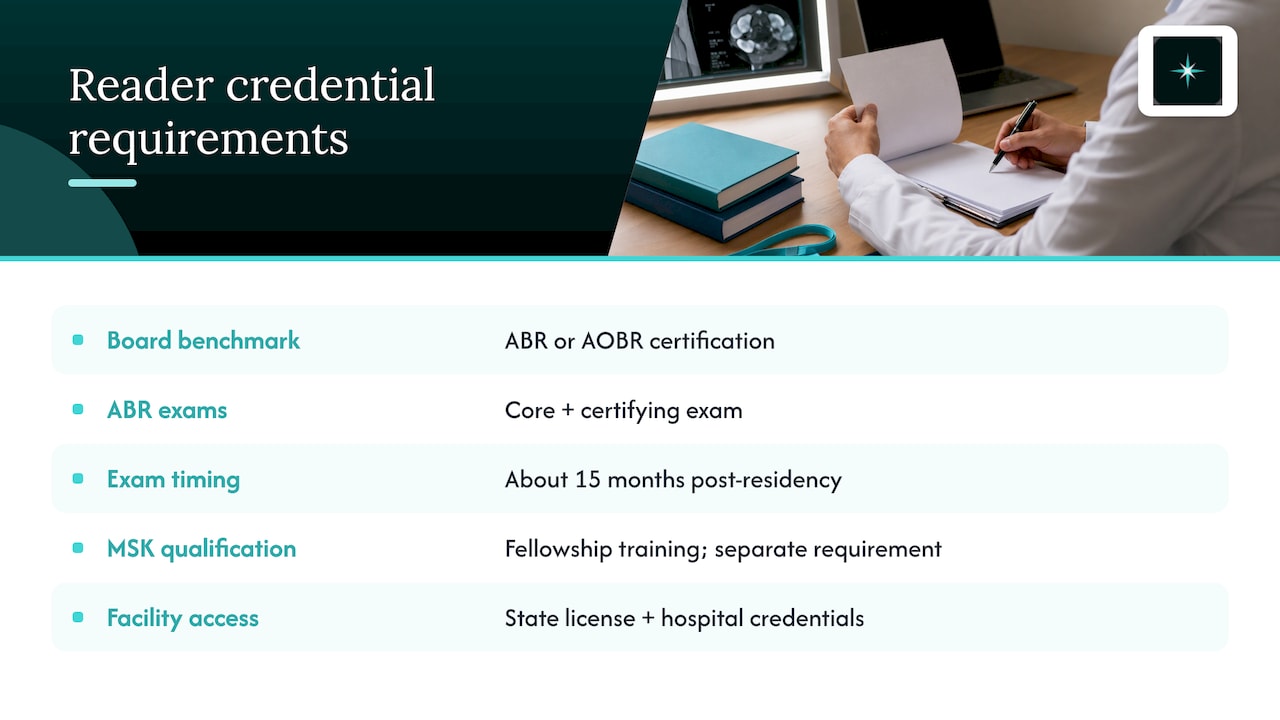
Require readers who hold ABR certification and subspecialty fellowship training in musculoskeletal radiology, plus the state licenses and hospital credentials your facility needs. ACGME sets certification by the ABR or the American Osteopathic Board of Radiology as the benchmark for subspecialty faculty, and credentialing committees commonly use that same benchmark when they vet outside readers.
One point trips up many first-time buyers. The U.S. Department of Defense's musculoskeletal radiology fellowship page states there is no separate subspecialty board exam for musculoskeletal radiology. Board certification is the ABR core exam during residency plus the certifying exam, which is typically taken about 15 months after residency. The MSK credential is therefore fellowship training on top of ABR certification, so write both into the contract as separate requirements.
Fellowship pathways also vary. The Bluth workforce study notes that ACGME-accredited and non-accredited fellowship pathways are not differentiated by higher or lower value, which is why a contract should specify the training you require rather than rely on a label.
What a hospital RFP actually asks for
The Nassau Health Care Corporation RFP is a useful template because it spells out what a public hospital wanted in 2023: ABR-certified radiologists with subspecialty fellowship training, familiarity with HL7 interfaces, reads dictated into the hospital PACS, verbal communication of critical findings, and radiologists licensed in New York who meet the hospital's credentialing standards. Your own list will differ in detail, but the categories are the same: training, integration, communication and licensure.
State licensure and credentialing
A radiologist must hold a license in the state where the patient is imaged, and your hospital's medical staff office must credential each reader. At AstraRad, radiologists are licensed in all 50 states, which removes the state-by-state matching problem from your side of the contract. Our state licensing page explains how coverage works across state lines. Your credentialing file should still list each radiologist who will read for you, so ask that the contract commits the provider to supply the documents your medical staff office requires.
How does teleradiology work for orthopedic practices, from image transfer to signed report?
The flow runs in five steps: the study is acquired, sent to the provider over a DICOM connection, routed to a matched subspecialist, read and signed, and returned to your PACS. DICOM is the standard file and network format for medical images. The reader works in a diagnostic viewing environment, so the image quality your technologist captures is the image quality the radiologist reads.
- Acquisition. Your technologist completes the exam and verifies protocol, laterality and patient demographics. Errors here create report errors later.
- Transfer. The images and order data go to the provider through a DICOM-conformant connection. The turnaround clock starts when the last image arrives.
- Routing. The study is assigned by modality and body part to a subspecialist on shift.
- Interpretation and signature. The radiologist compares priors, interprets, and signs the report. Critical findings are communicated by direct contact under the escalation rule in your contract.
- Return. The signed report is delivered into your PACS, where the referring orthopedist or sports medicine physician already looks for results.
AstraRad is a US teleradiology service that delivers final signed reports read by board-certified subspecialists. Our reports go straight into the client's existing PACS with no extra portal, and our connection is DICOM conformant. For a practice with a small IT team, that means referring clinicians do not learn another login. The PACS integration guide covers how the connection to a teleradiology provider is set up.
What turnaround times and hours should an MSK radiology contract define?
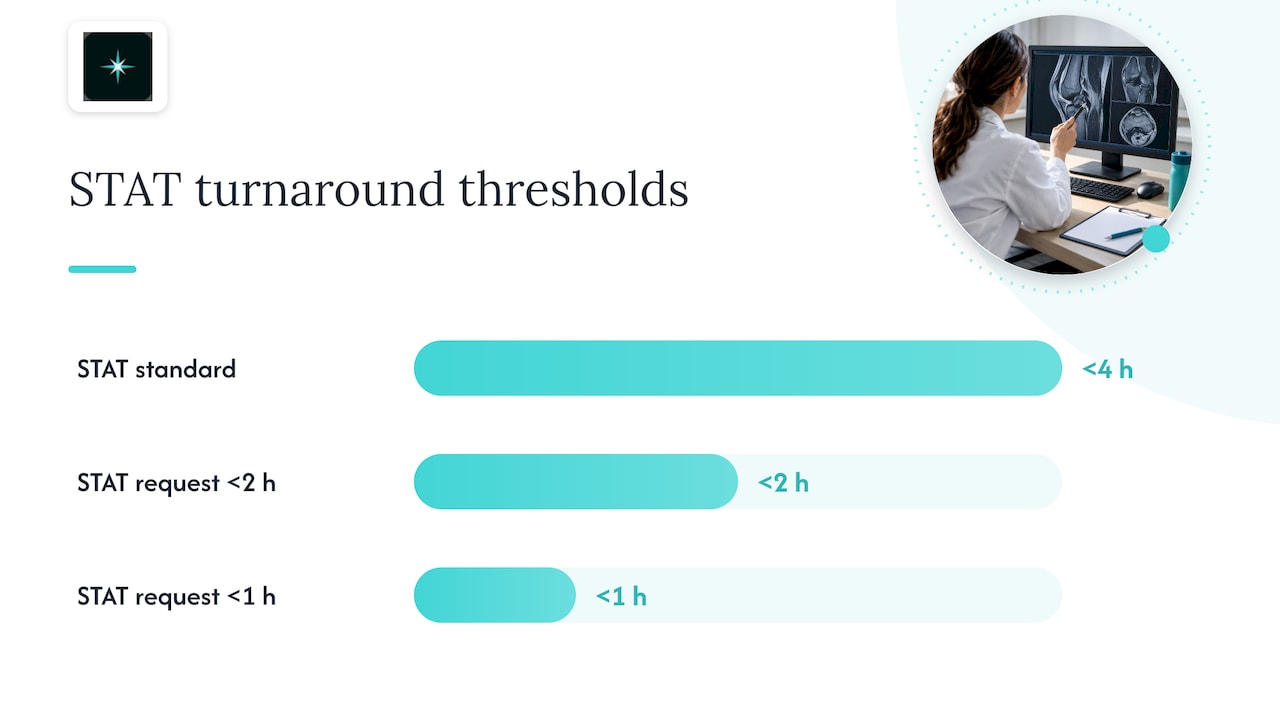
Define a turnaround commitment for each priority tier, state where the clock starts and stops, and require 24/7/365 coverage if you take trauma or after-hours referrals. Without a stated clock, a promise of a fast read can mean anything from image arrival to the moment a report reaches a clinician.
The cleanest definition measures from last-image arrival to radiologist signature. Our commitments use that measure, written into the contract:
| Tier | Committed turnaround | Typical MSK use |
|---|---|---|
| STAT | Under 4 hours; under 2 hours or under 1 hour on request | Acute trauma, suspected fracture complications, post-operative concerns |
| Routine | 24 to 48 hours | Outpatient sports medicine MRI, follow-up radiographs, ultrasound |
| Stroke protocol | Under 30 minutes | Neuro emergencies in hospital settings |
The tiers are STAT, routine and stroke protocol, and every one of them ends in a final signed report, including overnight. Notice what a buyer gets from this structure: orthopedic clinic imaging that is not time-critical can sit in the routine tier, while the emergency department's trauma studies use STAT. That split lets you match the commitment to the clinical need rather than paying for the fastest tier on every study.
Escalation and operating hours
Write down who the radiologist calls for a critical finding, within what time frame, and how the call is documented. The Nassau RFP required verbal communication of critical findings, and that expectation is common in hospital contracts. Also define what happens when a study arrives with missing priors, wrong laterality or a poor-quality image: does the clock pause, and who contacts your site?
Hours matter for orthopedic and sports medicine work more than buyers expect. Weekend tournaments, evening clinics and holiday trauma all generate studies outside weekday hours. Scheduled US shifts 24/7/365 mean the same commitment applies at 2 a.m. as at 2 p.m., and that is the term to compare across proposals. Our STAT read guide explains ordering criteria for urgent studies.
How is MSK teleradiology contracted and priced?
Most MSK teleradiology is contracted per report, per study type, with a written SLA and a BAA. The price per read depends on modality and tier, and the contract should also define onboarding, quality assurance, termination and what counts as a billable study. Our guide to teleradiologist contracts lists what to require before signing.
AstraRad is a US teleradiology service that delivers final signed reports read by board-certified subspecialists. Our pricing is per report with no minimums, and the first signed report arrives within 10 business days of countersignature. You can request a complete per-report rate card, which is delivered within one business day. After a discovery call, a coverage plan with SLA terms in writing follows.
Contract structures compared
| Structure | How you pay | What to confirm |
|---|---|---|
| Per report, no minimums | A rate for each signed report, by study type and tier | Rate card scope, tier definitions, billable study rules |
| Per report with volume commitment | A rate per report plus a monthly or annual volume floor | Floor level, shortfall treatment, rate changes |
| Flat fee or block | A set amount for a coverage period or study block | Block size, expiry, overflow rates |
Per-report pricing with no minimums fits MSK work well because orthopedic volume is seasonal. Sports medicine imaging rises with school and amateur sports seasons, and trauma volume shifts with weather and holidays. A contract that bills only for signed reports follows that curve without leaving you holding unused commitments.
Terms every MSK SLA should define
- Turnaround by tier, with the start and stop of the clock written out.
- Final versus preliminary reports, stated for every tier.
- Quality assurance. Peer review is a structured process in which radiologists re-read a sample of cases to check accuracy. At AstraRad, 1 in 20 reports is independently double-read, blind, for peer review. Our RADPEER explainer shows how scoring works in the field.
- Compliance. A business associate agreement (BAA) is the HIPAA-required contract under which a vendor handles protected health information for a covered entity. AstraRad is HIPAA aligned and works as a business associate under a signed BAA.
- Backlog handling, so a surge in studies does not push your own turnaround outside your clinics' needs.
What should administrators check for PACS, HIPAA and quality assurance?
Check four items before signing: how reports return to your PACS, how the provider handles protected health information, how quality is measured, and how coverage grows if your volume does. Each item should appear in the contract as a defined term rather than a verbal assurance.
PACS, or picture archiving and communication system, is the software your facility uses to store and view medical images and reports. HL7 is the messaging standard that carries orders and results between systems. Ask whether the provider reports into your existing PACS, because a separate portal creates a second place for orthopedists to look. Practices that already pair on-site radiology and diagnostic testing with outside subspecialty reads feel this most, since their clinicians expect results to appear in one chart.
| Item | What to confirm in the contract |
|---|---|
| PACS and RIS integration | Reports return directly to your PACS; DICOM conformance; orders and results through your existing interfaces |
| Licensure and credentialing | State licenses in each state you image; documents your medical staff office needs |
| HIPAA safeguards | Signed BAA; breach notification terms |
| Quality assurance | Peer review rate, scoring method, how discrepancies reach you |
| Capacity | Backlog clearance, overflow handling, onboarding time |
Our subspecialty coverage matrix shows how to lay out these requirements by subspecialty for a hospital contract.
How can AstraRad support your MSK radiology coverage?
AstraRad is a US teleradiology service that delivers final signed reports read by board-certified subspecialists. For MSK work, that means joint, spine and extremity studies routed to a subspecialist matched to the modality and body part, final signed reports at every tier, and turnaround committed by contract.
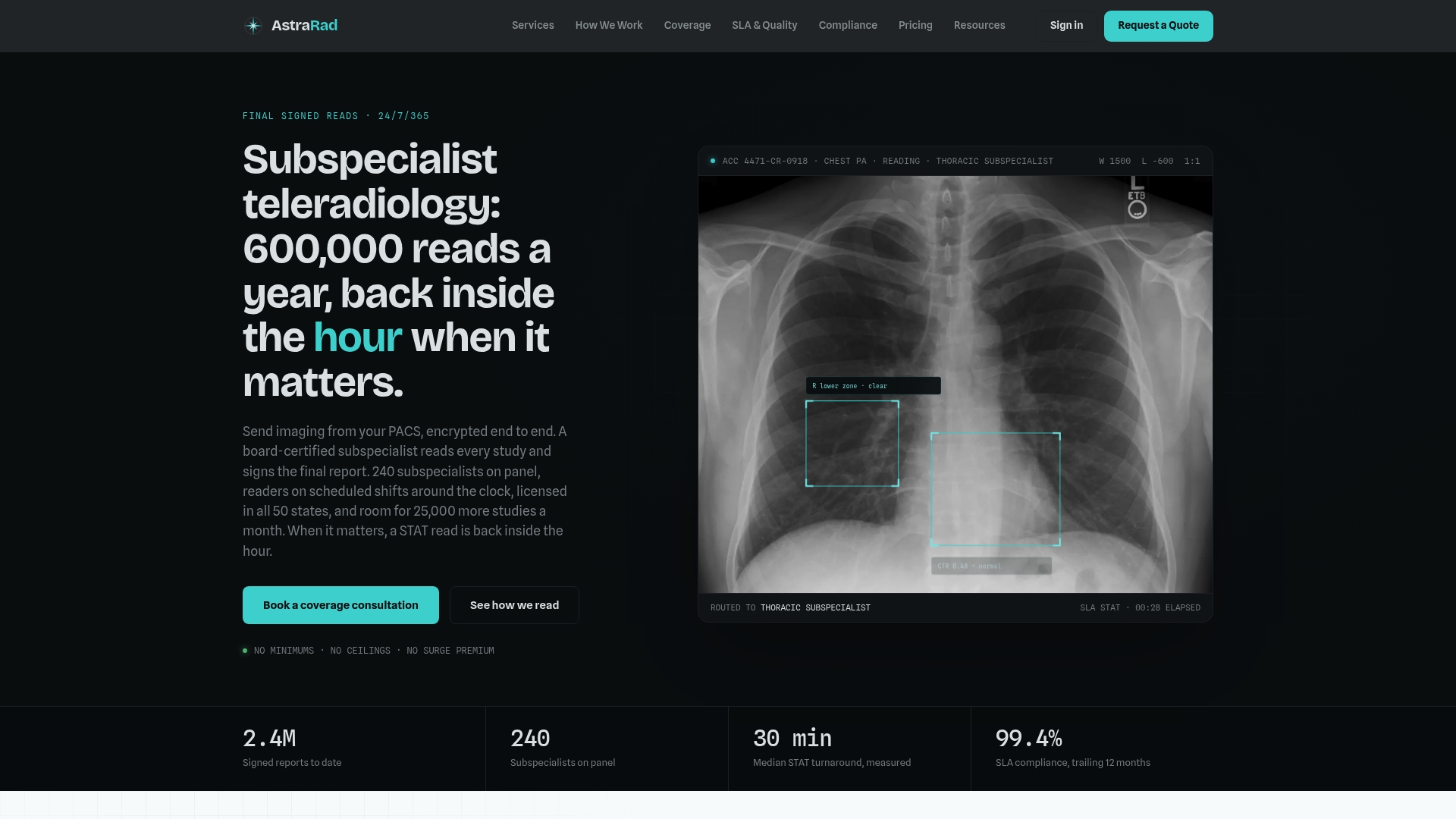
Our MRI teleradiology and X-ray and ultrasound overflow reads pages describe the study types in detail, and the musculoskeletal teleradiology resource covers SLA tiers and PACS handling. Pricing is per report with no minimums, so you pay for signed reports and nothing else.
Sources
- ACGME Program Requirements for Graduate Medical Education in Musculoskeletal Radiology (2025)
- Bluth et al., Medical workforce in the United States (2022), PubMed Central
- U.S. Defense Health Agency, Radiology - Musculoskeletal fellowship
- Nassau Health Care Corporation, Teleradiology Services RFP (2023)
- Cigna Musculoskeletal Imaging Guidelines V1.0.2026
AstraRad is a US teleradiology service that delivers final signed reports read by board-certified subspecialists. To set up MSK coverage with SLA terms in writing, book a discovery call or request the per-report rate card.
Frequently asked questions
What does MSK radiology coverage include?
It includes subspecialist interpretation of musculoskeletal imaging: X-ray, MRI, CT, ultrasound, arthrography and bone scans. The provider returns a final signed report to your PACS within the turnaround committed for each tier. Your contract should list the study types, body parts, hours, escalation steps and quality assurance terms.
Can teleradiology handle sports medicine MRI reads?
Yes. Sports medicine MRI covers knee, shoulder, hip, ankle and elbow studies, which a teleradiology provider can route to a matched subspecialist and return as signed reports. Specify the joints you scan, your protocols and the routine turnaround you need, so reads from outpatient clinics are handled on a predictable schedule.
How does turnaround work for orthopedic practices?
Turnaround is measured from last-image arrival to radiologist signature and set per tier. Our commitments are STAT under 4 hours, routine 24 to 48 hours, and stroke protocol under 30 minutes. Most orthopedic clinic studies fit routine, while acute trauma fits STAT. The contract should state the clock and the tier for each study type.
How is MSK teleradiology priced?
Most agreements price each signed report by study type and tier. Our pricing is per report with no minimums, and a complete rate card is delivered within one business day of your request for the rate card. Ask each provider to state what counts as a billable study and how tier changes are billed.
What credentials should MSK readers hold?
Require ABR certification, fellowship training in musculoskeletal radiology, licensure in the state where the patient is imaged, and credentialing that meets your medical staff rules. ACGME sets ABR or American Osteopathic Board of Radiology certification as the benchmark for subspecialty faculty. Our radiologists are licensed in all 50 states.
Related on AstraRad
- Resources
Per-report radiology billing: audit the invoice in 6 checks
Per-report radiology billing should reconcile to your own accession count. Six checks catch the true-ups, multipliers, and addenda that inflate a month.
- Resources
Imaging center overflow reporting: how it works
Imaging center overflow reporting explained: when to use it, what to put in the contract, and how final signed radiology reports reach your PACS.
- Resources
SLA clauses for healthcare vendors: a buyer's guide
SLA clauses for healthcare vendors: the metrics, remedies, BAA terms and exit rights US hospital and imaging center buyers should put in writing.
Put a radiologist's name on your next read.
Tell us your modalities and monthly volume. A complete per-report rate card, with turnaround tiers and SLA terms in writing, lands in your inbox within one business day.